Ixia
Ixia Xcellon-Ultra NP: 12×1GbE + 1×10GbE Layer 4-7 Load Module — 43 Refurbished Units In Stock
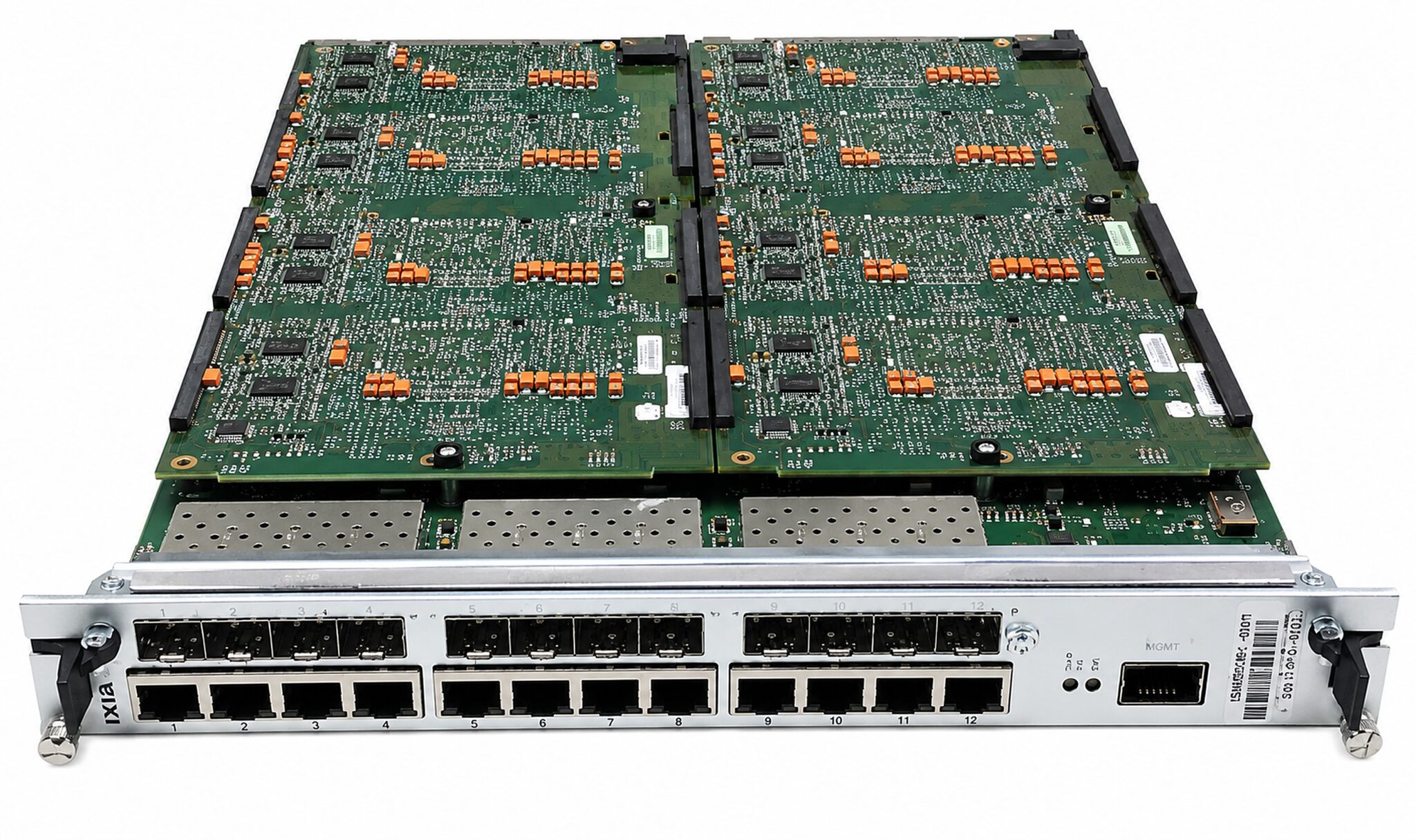
If you run a network test lab and need realistic, high-scale Layer 4-7 application and load testing at gigabit speeds, the Ixia Xcellon-Ultra NP High Performance Load Module (also written XCELLON-ULTRA NP, Xcellon Ultra NP, and XcellonUltraNP) is one of the most cost-effective ways to get there. It packs twelve 1GbE (Gigabit Ethernet) ports plus one 10GbE port onto a single Ixia Optixia XM-form-factor load module, and it was engineered specifically for stateful, application-aware traffic generation with Ixia’s IxLoad software. We currently have 43 refurbished units in stock, each fully tested, shipped with a comprehensive test report, and backed by a one-year warranty.
This post explains exactly what the Xcellon-Ultra NP does, its verified technical specifications, the older Ixia load modules it replaces, the competitor modules it goes head-to-head with, and why 1GbE and mixed 1G/10G application testing still matters in 2026.
What the Xcellon-Ultra NP Load Module Does
The Xcellon-Ultra NP is a network-processor-based application and load test module. Unlike a plain stateless traffic generator, it is built to emulate real clients and servers and to push stateful, Layer 4 through Layer 7 traffic through a device under test. This makes it a natural fit for validating firewalls, load balancers / application delivery controllers (ADCs), servers, deep packet inspection (DPI) devices, and converged “triple-play” network devices.
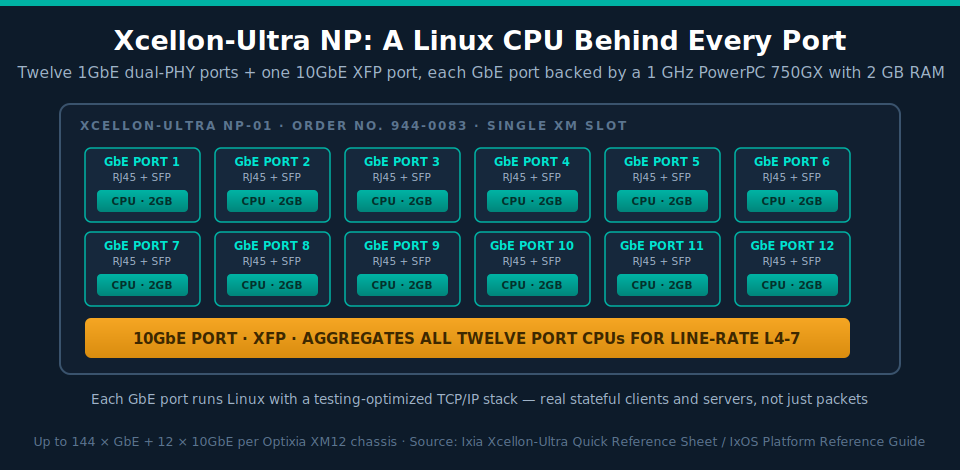
Its defining feature is the per-port network processor architecture. Each of the twelve Gigabit Ethernet ports contains a powerful RISC processor running Linux together with a complete, testing-optimized TCP/IP stack. The module can combine the processing power and resources of up to twelve per-port CPUs into a single physical port, delivering the highest Layer 4-7 line-rate performance in its class. Any of the twelve GbE ports can be used individually, or all twelve can be aggregated through the single 10GbE port.
The Xcellon-Ultra NP is driven by Ixia’s (now Keysight’s) family of test applications:
- IxLoad — the primary application. It creates real-world Layer 4 (TCP/UDP) and Layer 7 (application) traffic, emulating clients and servers for Web (HTTP, SSL), FTP, email (SMTP, POP3, IMAP), streaming (RTP, RTSP), video (MPEG2, MPEG4, IGMP), voice (SIP, MGCP), and infrastructure services such as DNS, DHCP, LDAP, and Telnet. Advanced subscriber-modeling capabilities let you validate quality of experience (QoE) for data, voice, and video subscribers.
- IxNetwork — integrated Layer 2-3 data/control-plane performance and functional testing, supporting routing, bridging, MPLS, and multicast protocols.
- IxExplorer — Layer 2-3 wire-speed stateless traffic generation and analysis.
- IxAutomate, IxChariot, IxAccess, IxVPN, a Tcl API, and a Linux SDK round out the supported tool set.
The card can also operate in IxN2X mode (in which IxExplorer reports it as an Xcellon-Ultra NG), reflecting its lineage across Ixia’s application-testing platforms.
Verified Technical Specifications
The following specifications are drawn from Ixia’s Xcellon-Ultra Quick Reference Sheet and the IxOS Platform Reference Guide (Network Processor Load Modules chapter). We have flagged the handful of items that we could not independently confirm rather than guessing.
Ports and interfaces – 12 × Gigabit Ethernet (10/100/1000 Mbps) ports + 1 × 10GbE port on a single XM-form-factor module. – GbE port connectors: dual-PHY — RJ-45 (copper) and SFP (fiber). Fiber SFP options include SFP-SX (850nm) and SFP-LX (1310nm). Copper supports auto-negotiable 10/100/1000BASE-T. – 10GbE port connector: XFP (options: XFP-850, XFP-1310, XFP-1550). – GbE port interfaces include 1000BASE-X, 100BASE-FX, 100BASE-TX, 10BASE-T, and 10/100/1000BASE-T (aggregate/copper mode); the 10G port supports 10GBASE-X / 10G LAN XFP.
Ordering / part number – Price-list name Xcellon-Ultra NP-01; Ixia order number 944-0083. (The related XP variant is Xcellon-Ultra XP-01 and the IxN2X-capable variant is Xcellon-Ultra NG-01.)
Processing (the “NP” difference) – Twelve PowerPC 750GX port CPUs, running at 1 GHz with 2 GB of memory per GbE port. (The lower-cost Xcellon-Ultra XP uses PowerPC 750GL CPUs at 800 MHz with 1 GB per port — the NP is the higher-memory, higher-clock member of the family.) – Each GbE port runs Linux with a test-optimized TCP/IP stack; multiple network processors per port are optimized for Layer 4-7 testing.
Modes of operation
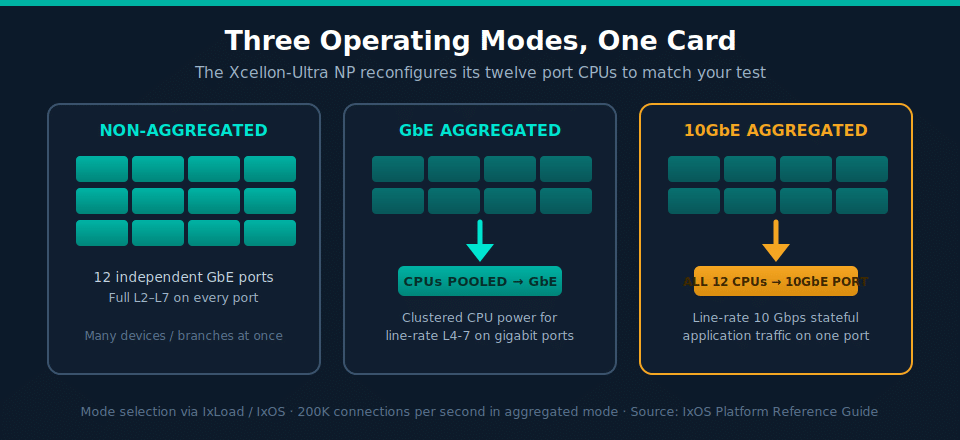
- Non-aggregated (normal) mode — all twelve 10/100/1000 ports provide independent L2-L7 functionality; 10GbE port disabled.
- Gigabit aggregated mode — port CPUs pooled/clustered across the GbE ports for line-rate L4-7; 10GbE port disabled.
- 10GbE aggregated mode — all twelve port CPUs assigned to the single 10GbE port for line-rate (10 Gbps) L4-7 testing; the twelve GbE ports are disabled.
Scale, capture, and measurement – Capture buffer: 64 MB per port (32 MB with the Packet Group Engine enabled). – Transmit flows per port: billions (sequential values) / 98K (arbitrary values). – Trackable receive flows per port (PGIDs): 128K. – Stream definitions per port: up to 4,096 (4K) in Packet Stream or Advanced Stream mode, each capable of generating millions of unique flows. – Latency measurement resolution: 20 ns. – Connection rate: 200K connections per second in aggregated mode (per Ixia’s IxOS Reference Guide specification table). – Wire-speed transmit/receive engines with timestamps, sequence numbers, data-integrity signatures, and packet-group signatures; hardware checksum generation for IPv4, IPv6, UDP, and TCP. – An RTP engine built into the FPGA can generate and terminate audio streams (video/data optional), working with IxLoad’s VoIP Peer signaling. – IEEE 1588v2 Precision Time Protocol (PTP) is listed as supported on the Xcellon-Ultra family.
Protocols and emulations – Layer 2-3: IPv4/IPv6 routing (BGP-4, OSPF, IS-IS, RIP), MPLS (RSVP-TE, LDP, L2/L3 MPLS VPNs, VPLS), multicast (IGMP, MLD, PIM-SM), and bridging (STP, RSTP, MSTP). Flexible header control for Ethernet, IPv4/v6, IPX, ARP, TCP, UDP, VLAN, QinQ, MPLS, GRE, and more. – Layer 4-7: HTTP, SSL, FTP, SMTP/POP3/IMAP, RTP/RTSP, MPEG2/MPEG4, SIP/MGCP, DNS, DHCP, LDAP, Telnet, and subscriber/QoE emulation via IxLoad. RFC-based benchmarking (e.g., RFC 2544-style throughput/latency methodology) is supported through the Ixia application suite.
Chassis, capacity, and environment – Chassis slot requirements: occupies one XM-form-factor slot. Compatible Ixia Optixia chassis include the XM2 (2-slot portable), XM12 (12-slot), and the newer XG12 and XGS12 platforms that accept XM-form-factor load modules. – Maximum density: up to 144 GbE + 12 × 10GbE ports in a single Optixia XM12; up to 24 GbE ports in an XM2. – Multi-user support: yes — Ixia chassis use a per-port user ownership model, so multiple engineers can share one chassis simultaneously. – Operating temperature: 5 °C to 30 °C (41 °F to 86 °F). Note that installing this high-powered module can lower the host chassis’s maximum operating temperature.
Not independently verified: exact physical dimensions, module weight, and per-module power draw for the Xcellon-Ultra NP were not confirmed in the datasheets we reviewed; request these from us if they are critical to your deployment and we will confirm against the physical unit.
Older Ixia Modules the Xcellon-Ultra NP Replaces or Consolidates
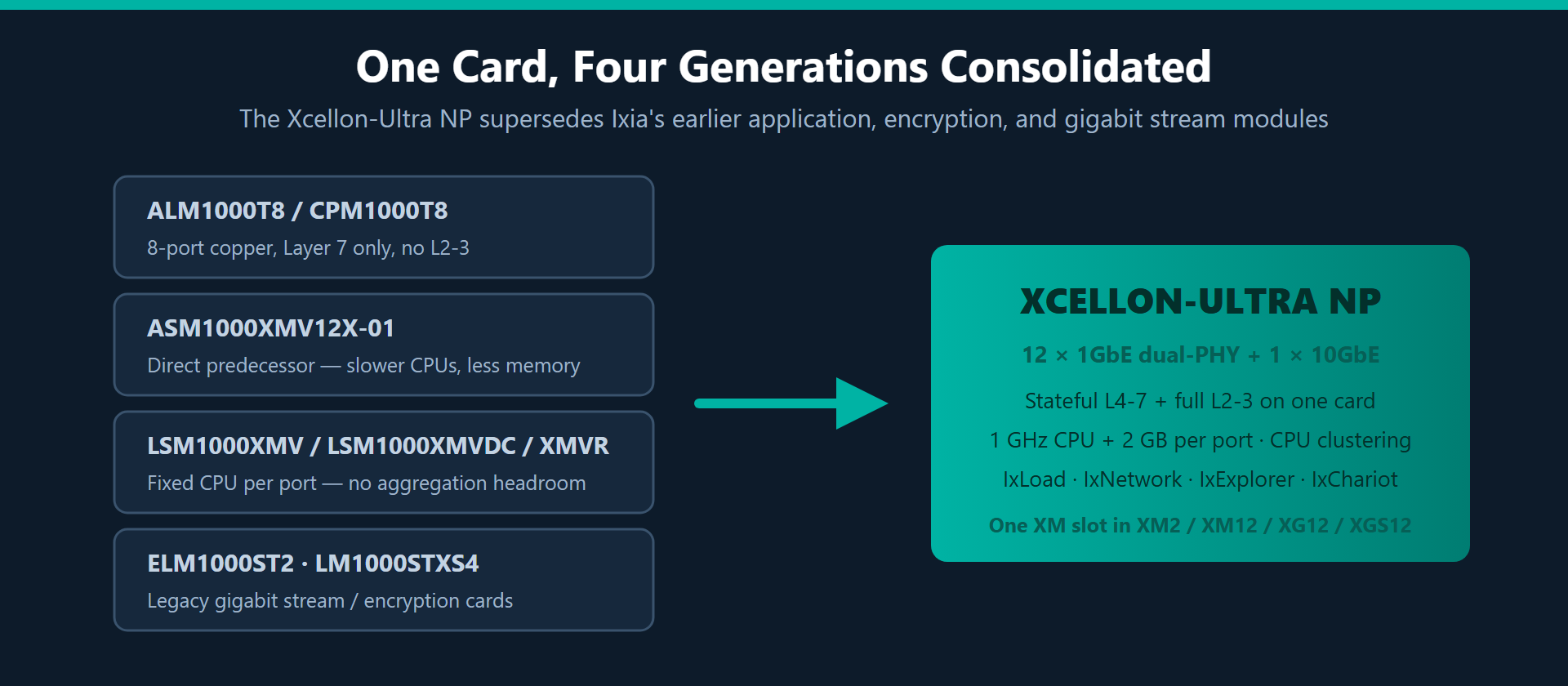
One of the strongest reasons to buy the Xcellon-Ultra NP today is consolidation. It folds the capability of several earlier, narrower Ixia cards into one 12+1 module with a modern network-processor engine:
- ALM1000T8 / CPM1000T8 Application Load Module — an 8-port 10/100/1000 copper, Layer 7-only card (each port an embedded Linux CPU) that supported IxChariot and IxLoad. The Xcellon-Ultra NP delivers the same application-layer testing with more ports, far more per-port CPU and memory, full Layer 2-3 capability, and a 10GbE aggregation path the ALM1000T8 never had.
- ELM1000ST2 Encryption Load Module and the older LM1000STX2/STX4 and LM1000STXS2/STXS4 stream cards — legacy Gigabit stream/encryption modules. The Xcellon-Ultra NP absorbs their stateless stream generation into its hardware stream engine while adding true stateful L4-7 emulation (IPSec/VPN work is handled through IxVPN on the platform).
- ASM1000XMV12X-01 Application/Streams Module — this is the Xcellon-Ultra NP’s direct architectural predecessor: the same 12 × GbE + 1 × 10GbE aggregation concept and three operating modes. The Xcellon-Ultra NP is effectively its higher-performance successor (faster PowerPC 750GX CPUs, 2 GB per port), so if you’re standardizing a lab, the NP supersedes the ASM1000XMV12X.
- LSM1000XMV4/8/12/16-01 (NGY) Gigabit LAN Service Modules, the LSM1000XMVDC dual-media variants, and LSM1000XMVR reduced cards — these dual-PHY (RJ45 + SFP) 1GbE cards cover L2-3 and L4-7 but fix CPU resources per port. The Xcellon-Ultra NP’s ability to cluster/aggregate its twelve CPUs onto a single port — or onto the 10GbE port — gives it a line-rate L4-7 headroom the fixed-resource LSM cards can’t match, plus native mixed 1G/10G testing on one card.
Where it sits in the Xcellon-Ultra family: The load-module family includes the Xcellon-Ultra XP-01 (800 MHz / 1 GB per port), the Xcellon-Ultra NP-01 (1 GHz / 2 GB per port — the unit here), and the Xcellon-Ultra NG-01 (physically similar, adds IxN2X-mode operation). Ixia also sold rack-mount appliance versions under the same Xcellon-Ultra brand — the XT80 (up to 80 Gbps of application traffic across 8 × 10GbE ports), XT80v2, and the IPSec-focused XTS16 / XTS40 — but those are 10GbE-only appliances. The NP load module remains the go-to choice when you specifically need high-density 1GbE plus a 10GbE aggregation port in a modular Optixia chassis.
Competitor Modules the Xcellon-Ultra NP Replaces or Competes With
If you’re cross-shopping the secondary market, the Xcellon-Ultra NP replaces or competes with these Layer 4-7 and 1GbE test products from other vendors — useful to know whether you’re consolidating a mixed lab or matching an existing test methodology:
- Spirent TestCenter CM-1G-D12 (HyperMetrics CM 10/100/1000 Dual-Media 12-port) and its 4-port sibling CM-1G-D4 — the closest direct analog: a 12-port dual-media gigabit module that combines TestCenter network emulation with line-rate Avalanche application traffic for L2-7 testing. The Xcellon-Ultra NP targets exactly this use case with its own 12+1 layout.
- Spirent Avalanche appliances for L4-7 — the Avalanche 290 (portable, up to ~2 Gbps), Avalanche 3100 / 3100B (high-density 1Gbps plus up to four 10Gbps interfaces), and the higher-end Spirent TestCenter C100 (SPT-C100) for multi-10G stateful L4-7 and security testing. The Xcellon-Ultra NP addresses the same firewall/ADC/DPI performance and security test cases at gigabit scale.
- Teledyne LeCroy Xena (formerly Xena Networks) stateful L4-7 platforms — the Vulcan family (VulcanBay, VulcanCompact) for stateful TCP/UDP and TLS load testing, plus Xena’s Odin 1G stateless modules (Z01s / Z01sx Odin, Z10cc Odin). Xena’s Vulcan competes for the stateful firewall/NGFW test dollar; the Xcellon-Ultra NP is the Ixia-ecosystem alternative.
- Agilent / Keysight N2X — the N5540A portable chassis with 10/100/1000 test cards such as the N5551A 4-port XR-2 tri-rate module. N2X is a prior-generation multiservice tester; labs migrating off N2X often standardize on Ixia IxLoad-driven hardware like the Xcellon-Ultra NP.
- BreakingPoint (Ixia/Keysight) — the L4-7 application-and-security platform. It occupies the same competitive space for firewall and IPS/NGFW validation; the Xcellon-Ultra NP is a lower-cost way to get IxLoad-based L4-7 lab capacity when you don’t need BreakingPoint’s massive-scale security library.
Why 1GbE and Mixed 1G/10G Application Testing Still Matters in 2026
It’s tempting to assume everything has moved to 25G, 100G, and beyond — but the numbers say otherwise. Gigabit Ethernet remains firmly entrenched at the access edge: industry analyses project the 1 Gbps segment to keep the largest share of the Ethernet switch market in 2026, and legacy 1GbE-and-below ports still account for roughly four in ten enterprise switch ports. Even as 10 Gbps climbs, 1G is being right-sized rather than retired — and every one of those gigabit ports needs to be tested.
That has direct implications for test labs:
- Enterprise access, branch, and campus edge are still heavily 1GbE. If you build or validate firewalls, routers, switches, load balancers, or SD-WAN gateways, you need to characterize them at the speeds your customers actually deploy. A 12-port 1GbE card lets you emulate many branch sites or subscriber groups at once.
- IoT and OT devices overwhelmingly connect at 1GbE or slower, so realistic device- and gateway-testing happens at gigabit rates.
- Firewall and load-balancer regression testing is most meaningful at realistic enterprise speeds. Many branch and mid-range next-generation firewalls are rated in the low single-digit Gbps of threat-protection throughput — squarely within the Xcellon-Ultra NP’s sweet spot, where twelve 1GbE ports or a single aggregated 10GbE port can generate stateful L4-7 load and measure connections-per-second, concurrent connections, and QoE.
- Cost-effective L4-7 lab capacity. Buying new Keysight PerfectStorm, CloudStorm, or BreakingPoint hardware for gigabit-class regression work is expensive overkill. A refurbished Xcellon-Ultra NP gives you proven IxLoad-driven L4-7 capacity for a fraction of the price of new gear.
A note for buyers searching either brand: Ixia is now part of Keysight. Keysight completed its acquisition of Ixia in 2017 in a deal valued at approximately $1.6 billion, and Ixia — which at the time served the top network equipment manufacturers, most top-50 carriers, and a majority of the Fortune 100 — became Keysight’s Ixia Solutions Group. IxLoad, IxNetwork, and BreakingPoint are all Keysight products today — so whether you search for “Ixia load module” or “Keysight IxLoad module,” the Xcellon-Ultra NP is the same proven hardware. (Note that the NP-01 has reached end-of-sale status with Keysight, which is precisely why the refurbished market is the smart way to acquire it.)
Buy a Refurbished Ixia Xcellon-Ultra NP — 43 Units In Stock
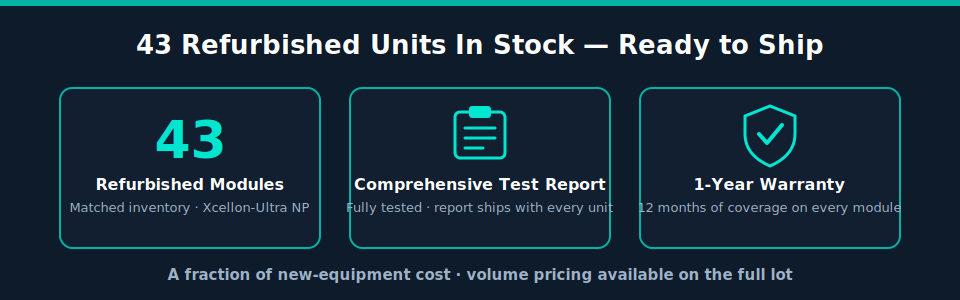
We have 43 refurbished Ixia Xcellon-Ultra NP load modules available right now — one of the largest single inventories of this card anywhere on the secondary market. This is the ideal buy for lab managers, test engineers, and procurement teams at network equipment makers, service providers, security vendors, and refurbished test-equipment buyers who need dependable IxLoad-based Layer 4-7 and 1GbE/10GbE test capacity without paying new-equipment prices.
Every refurbished unit we ship includes:
- A comprehensive test report — each module is fully tested and verified before it leaves our facility, and the test report ships with the unit so you know exactly what you’re getting.
- A full one-year warranty — every refurbished Xcellon-Ultra NP is backed by a one-year warranty for complete peace of mind.
- Significant savings versus new list price — buying refurbished lets you add or expand Ixia Optixia L4-7 test capacity at a fraction of the original cost, and with 43 units in stock we can support multi-card and full-chassis builds.
Whether you need a single Xcellon-Ultra NP to slot into an existing Optixia XM2, XM12, XG12, or XGS12 chassis, or a dozen cards to populate a high-density test bed, we can help.
Quantities are limited to the 43 units on hand.
View the refurbished Ixia Xcellon-Ultra NP product page and order now →
Or contact us directly for volume pricing on multiple units, a sample test report, or chassis-compatibility guidance:
Contact Zombie Components
Zombie Components LLC · 13177 Foothill Blvd, Sylmar, CA 91342