Ixia
Ixia Xcellon-Flex 16-Port 10GbE Load Modules: FlexAP10G16S vs. FlexFE10G16S — Refurbished & Fully Tested
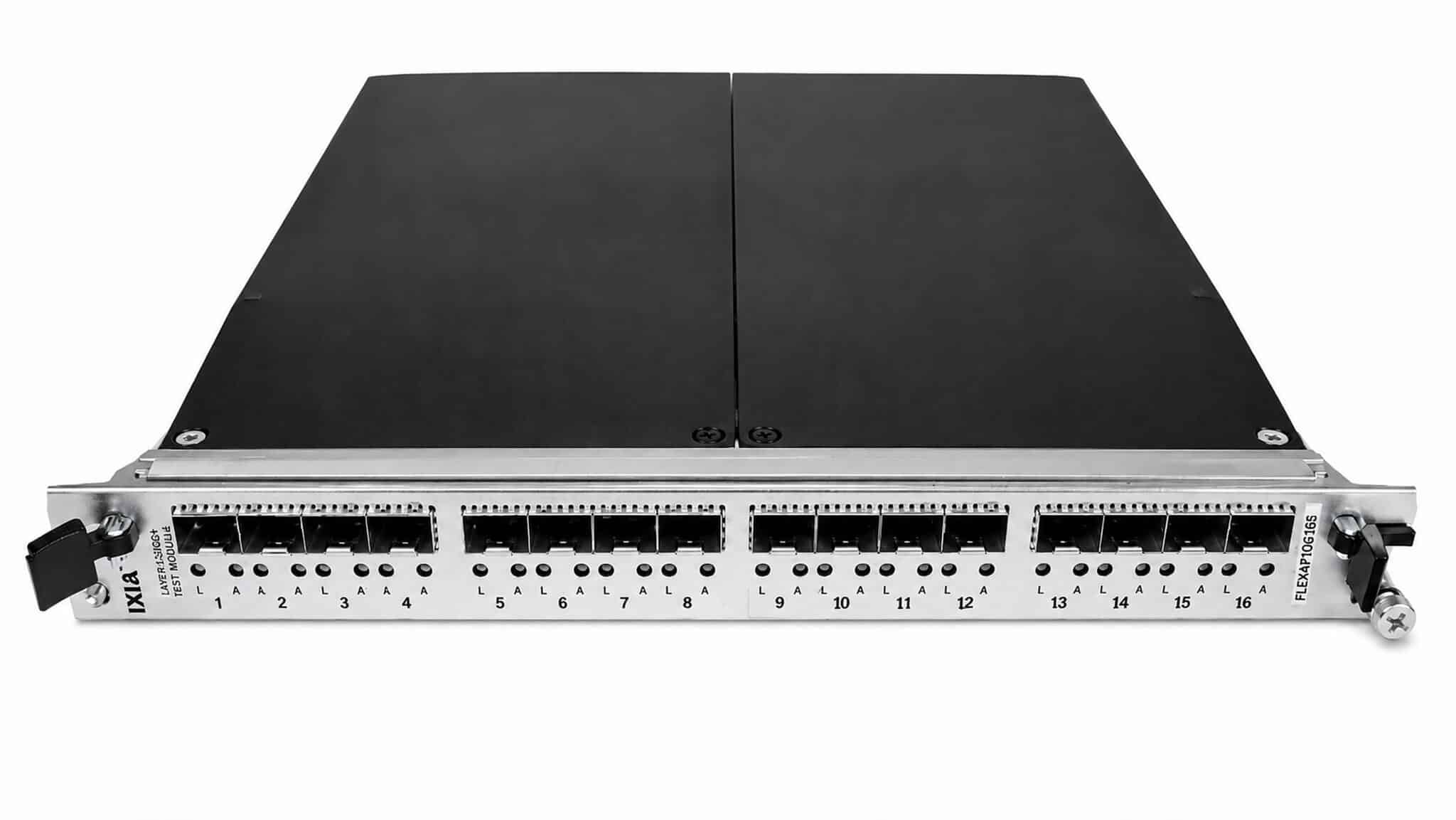
If your test plan needs sixteen ports of 10-Gigabit Ethernet in a single chassis slot — and you need to decide whether those ports have to run stateful Layer 4–7 application traffic or just wire-speed Layer 2–3 — the Ixia Xcellon-Flex family is the card that answers both questions. Two models share the same 16-port SFP+ front panel and the same single-slot footprint: the FlexAP10G16S (part number 944-1060), the Accelerated Performance card with full L2–7 support, and the FlexFE10G16S (part number 944-1061), the Full Emulation card built for L2–3 protocol emulation and scale testing.
We stock refurbished FlexAP10G16S modules — every unit fully tested in our own Optixia chassis and shipped with a comprehensive port-by-port test report, with a 90-day warranty included. Below is everything a lab manager, test engineer, or procurement lead needs to pick the right card the first time — including the chassis and cooling constraints that catch people out.
What the Xcellon-Flex 16-Port Modules Are Built For
Xcellon-Flex was Ixia’s highest-performance, highest-density 10GbE load module family, and Xcellon — the architecture behind it — is built around aggregation of multi-core CPUs and large per-port memory. That is what separates these cards from a pure data-plane traffic generator: they are designed to hold enormous numbers of emulated sessions and protocol instances, not just to push line-rate frames.
Typical applications include:
- Layer 4–7 application performance testing — the FlexAP10G16S runs under IxLoad for stateful HTTP, TCP, video, storage, and security-appliance testing at 10G line rates, alongside its L2–3 capability.
- High-scale routing and switching emulation — driven by IxNetwork, both cards emulate BGP4/BGP4+, OSPFv2/v3, IS-ISv4/v6, RIP/RIPng, EIGRP, PIM-SM/SSM, BFD, STP/RSTP/MSTP, and LACP.
- Data-center fabric validation — with the Data Center Bridging upgrade, FCoE/FIP, LLDP/DCBX, and IEEE 802.1Qbb priority-based flow control.
- MPLS and carrier-Ethernet scale testing — RSVP-TE, LDP, L3 MPLS VPN, VPLS, EVPN, MPLS-OAM, CFM/Y.1731, PBB, and 1588v2.
- Access and subscriber emulation — DHCPv4/v6, PPPoX/L2TP, ANCP, IGMP/MLD, and IPTV join/leave latency.
- NEM and regression test beds — 128 ports of 10GbE in a single XM12 High Performance chassis, running continuously without tying up higher-speed test gear.
The design philosophy is the opposite of a pure density play: maximum protocol and session scale per port, in a card that still puts sixteen 10GbE ports in one slot.
FlexAP10G16S vs. FlexFE10G16S: Which One Do You Need?
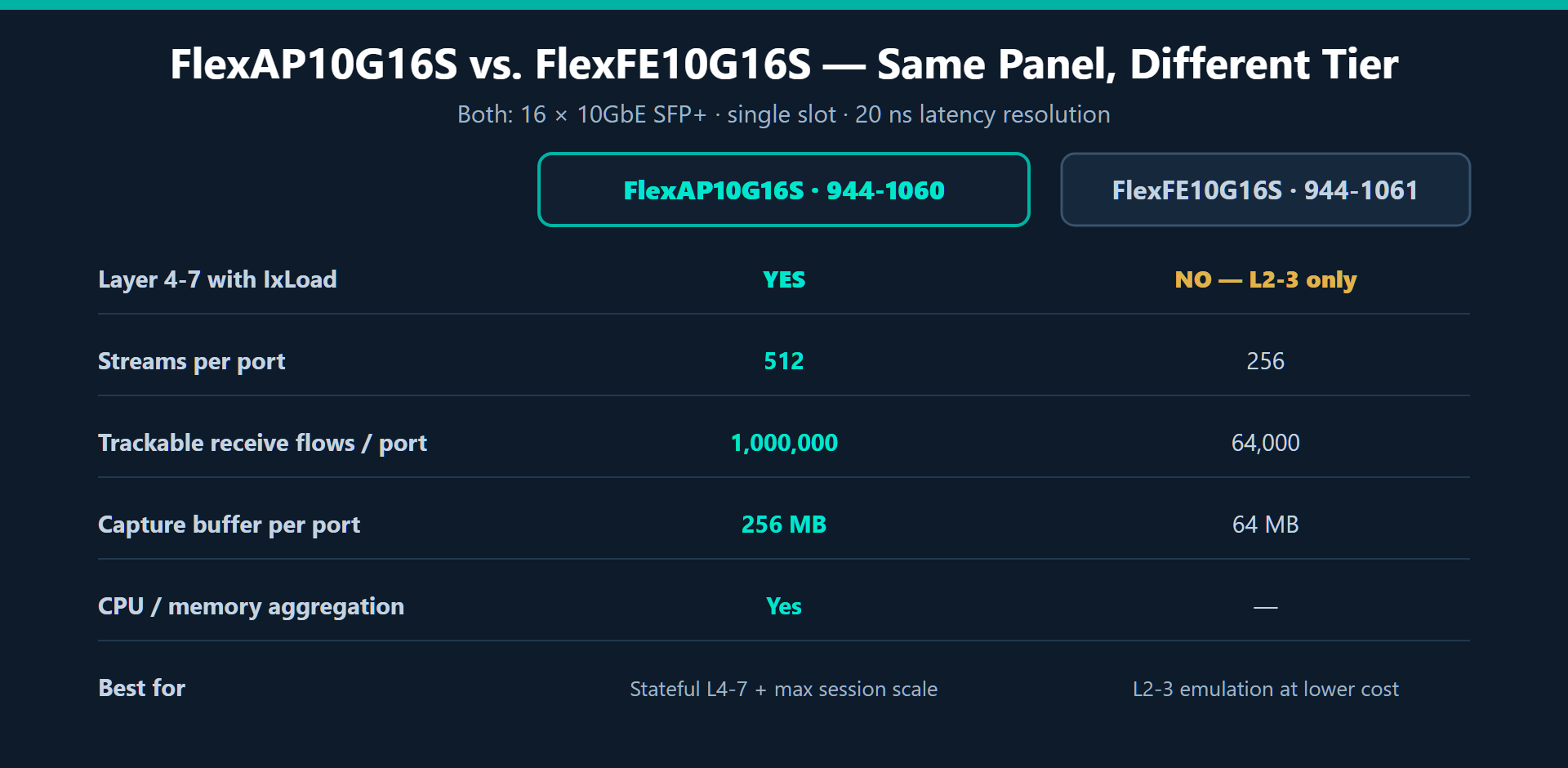
Both cards are 16-port, single-slot, SFP+, 10GbE LAN modules with multi-core processors and 20 ns latency resolution. The difference is the feature tier — and it is a real one, not a marketing split.
Choose the FlexAP10G16S (944-1060) if:
- You need Layer 4–7 application traffic testing with IxLoad. The Full Emulation card does not support it. This is the single most important dividing line.
- You need 512 stream definitions per port (256 in Data Center Bridging mode) rather than 256.
- You need to track 1 million receive flows per port rather than 64 K, or 1 million arbitrary-value transmit flows rather than 32 K.
- You need a 256 MB per-port capture buffer rather than 64 MB.
- You need 1 million table-UDF entries rather than 256 K.
- You want CPU and memory aggregation — borrowing the processing resources of neighbouring ports to drive ultra-high-scale protocol emulation on fewer ports.
Choose the FlexFE10G16S (944-1061) if:
- Your work is Layer 2–3 only — routing-protocol emulation, RFC benchmarking, switch and router scale testing — and you will never need IxLoad on these ports.
- You want the same 16-port density and the same chassis footprint at a lower cost per port.
- 256 streams per port, 64 K trackable receive flows, and a 64 MB capture buffer comfortably cover your test cases.
An honest note for buyers: if there is any chance your roadmap includes stateful application testing on these ports, buy the AP. The L4–7 capability is a hardware-tier difference and cannot be licensed onto a Full Emulation card later. We would rather tell you that now than process a return.
Full Technical Specifications
All specifications below come from the Ixia IxOS Platform Reference Guide (Xcellon-Flex Load Modules chapter) and Ixia’s Xcellon-Flex 10GbE Load Modules solution brief, document 915-3015-01 Rev B.
Ports, density, and form factor
- 16 × 10GbE SFP+ ports per module, occupying a single chassis slot
- Up to 128 ports of 10GbE in an Optixia XM12 High Performance chassis; 16 ports in an XM2 portable chassis; up to 192 ports in a 12-slot XGS12 chassis and 160 ports in an XG12
- 10GbE LAN interface protocol; SFP+ transceiver type with direct-attach copper support
- 2 LEDs per port (TX and RX), with link, activity, error, and loopback states
Optics and media
- SFP+ transceivers (sold separately): 10GBASE-SR/SW multimode (Ixia 948-0013) and 10GBASE-LR/LW single-mode (948-0014)
- SFP+ direct-attach copper cabling supported on both the AP and FE cards
- Latency self-calibration removes the intrinsic latency of any MSA-compliant transceiver, including unsupported optics
Traffic generation (transmit engine)
- Wire-speed packet generation with timestamps, sequence numbers, data-integrity signatures, and packet-group signatures
- Streams per port: 512 (FlexAP10G16S) / 256 (FlexFE10G16S) — halved in Data Center Bridging mode
- Advanced Scheduler streams per port: 512 (AP) / 256 (FE)
- Transmit flows per port: billions with sequential values; 1 million (AP) / 32 K (FE) with arbitrary values
- Table UDF: 1 million entries (AP) / 256 K entries (FE)
- Frame sizes: minimum 48 bytes at line rate (60 bytes with UDF enabled); maximum 9216 bytes on port 0, 2500 bytes on other ports; fixed, random, weighted-random, or user-defined increment
- User-defined fields: fixed, increment or decrement by user-defined step, value lists, range lists, cascade, random, and chained
- Hardware IPv4/IPv6/UDP/TCP checksum generation and verification; CRC good/bad/none, undersize, and oversize error generation
- Transmit line-clock adjustment of ±100 ppm, applied per card
Analysis (receive engine)
- Wire-speed packet filtering, capture, real-time latency and inter-arrival time per packet group, data integrity, and sequence checking
- Trackable receive flows: 1 million (AP) / 64 K (FE); packet-flow statistics track the same
- Per-port capture buffer: 256 MB (AP) / 64 MB (FE)
- Filters on 48-bit source/destination MAC addresses, two 128-bit user-definable patterns with offsets, frame-length ranges, CRC errors, data-integrity errors, and sequence-checking errors
- 64-bit statistics counters: link state, line speed, frames and bytes sent and received, fragments, undersize, oversize, CRC errors, VLAN-tagged frames, six user-defined stats, eight QoS counters, data-integrity and sequence-checking frames and errors, ARP, and ping requests and replies
Latency and timing
- 20 ns timestamp resolution on both cards
- Inter-burst gap from 6400 ns to 429 s at 10 Mbps, 640 ns to 42.9 s at 100 Mbps, and 64 ns to 16.7 ms at 1000 Mbps
- Link fault signalling with No Fault, Local Fault, and Remote Fault indication, including negative-test control over fault responses
Protocol emulation
- Routing and switching: BGP4/BGP4+, OSPFv2/v3, IS-ISv4/v6, RIP/RIPng, EIGRP/EIGRPv6, PIM-SM/SSM, BFD, STP/RSTP/MSTP/PVST+/RPVST+, LACP
- Data centre and SDN: PFC, FCoE/FIP, LLDP/DCBX, VNTAG/VNIC, VEPA, FabricPath, TRILL, SPBM, OpenFlow, VXLAN, Segment Routing IS-IS
- MPLS: RSVP-TE/P2MP, LDP/mLDP, L3 MPLS VPN/6VPE, LDP L2VPN (PWE/VPLS), BGP VPLS, multicast VPN, EVPN/PBB-EVPN, MPLS OAM, MPLS-TP
- Access: DHCPv4/v6, PPPoX/L2TP, ANCP, IPv6 autoconfiguration, DHCP over EoGRE, IGMP/MLD, IPTV join/leave latency
- Carrier Ethernet: Link OAM, CFM/Y.1731, PBB/PBB-TE, E-LMI, 1588v2 (PTP), ESMC, TWAMP
- Data Center Bridging is an optional protocol upgrade — confirm licensing against the chassis you are pairing these cards with
Chassis Compatibility, Power, and Cooling — Read This Before You Order
Xcellon-Flex cards are power-hungry and warm, and Ixia documented several hard constraints that are easy to miss. We would rather you know them up front:
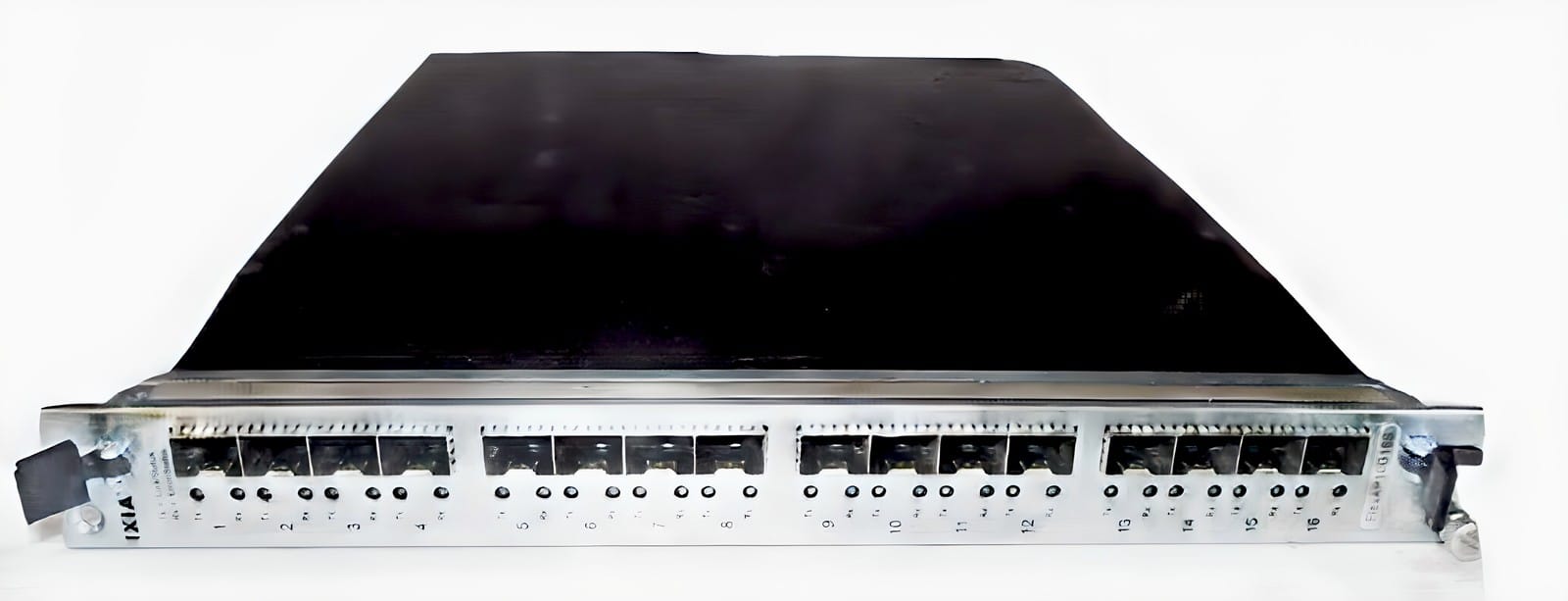
- An XM12 High Performance chassis is required to run 128 ports in a single chassis. If you have a standard XM12 (941-0002), it must be converted — a field-replaceable power-supply upgrade kit (943-0005) exists for exactly this.
- A maximum of eight Xcellon-Flex load modules may be installed at one time in an XM12 High Performance chassis. That is where the 128-port figure comes from — eight cards, not twelve.
- In a mixed HM12 High Performance chassis, the maximum module count depends on the total power draw of the specific card set. Plan the loadout, not just the slot count.
- The XM2 portable chassis (941-0003) supports exactly one FlexAP10G16S or FlexFE10G16S — 16 ports — and no other load module may share that chassis when a Xcellon-Flex card is installed.
- Ambient operating temperature is 5–30 °C (41–86 °F). With an Xcellon-Flex card installed in an XM12, the chassis maximum drops to 30 °C ambient. If your lab runs warm, size the cooling before the cards arrive.
- On XGS-generation chassis, twelve cards give 192 ports (XGS12-SD/SDL/HSL) and two cards give 32 ports (XGS2-SD/SDL/HSL); an XG12 supports ten cards for 160 ports.
If you are not sure which chassis revision you have, send us the chassis part number and we will confirm fit before you buy.
Which Older Ixia Modules the Xcellon-Flex Replaces
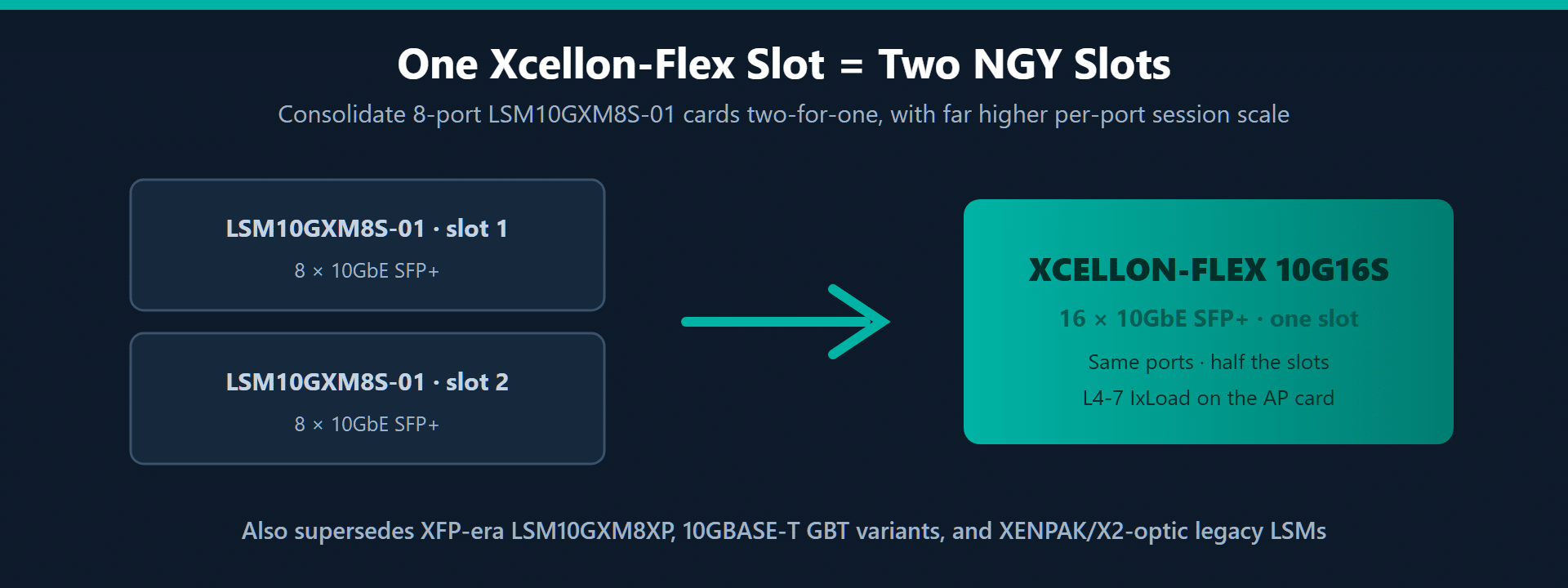
Xcellon-Flex arrived as the successor to Ixia’s 8-port-per-slot 10GbE generation, and it consolidates that hardware two-for-one:
- Ixia NGY series (LSM10GXM family). The LSM10GXM8S-01 (944-0051), LSM10GXM4S-01 (944-0050), and LSM10GXM2S-01 (944-0054), plus the XFP-based Extra Performance variants (LSM10GXM8XP-01) and the 10GBASE-T versions (LSM10GXM8GBT-01), all topped out at eight 10GbE ports per slot. One Xcellon-Flex card carries the port count of two of them, with far higher per-port session scale.
- Separate Layer 4–7 application modules. Before the FlexAP10G16S, running stateful application traffic alongside L2–3 emulation usually meant dedicating separate application-server modules to the job. The AP card collapses both roles into one slot under IxLoad and IxNetwork.
- Legacy Optixia 10GE LSMs. Early cards such as the LM10GEXENPAK, LSM10G1-01, and LSM10GL1-01 used bulky XENPAK, XFP, and X2 optics at a fraction of the density. Xcellon-Flex modernises all of it to compact SFP+.
If your lab is still running NGY inventory, a pair of refurbished Xcellon-Flex cards recovers slot capacity and adds session scale at the same time.
Competitor Modules It Replaces or Competes With
Cross-shopping brands? The 16-port Xcellon-Flex cards compete directly with — and for many labs replace — these 10GbE test modules:
- Spirent TestCenter HyperMetrics dX — DX-10G-S32. Spirent’s 32-port 10G SFP+ card is a double-height module occupying two chassis slots, which works out to the same 16 ports per slot as an Xcellon-Flex card.
- Spirent HyperMetrics mX — MX-10G-S8 and CV-10G-S8. Spirent’s 8-port 10G SFP+ modules for L2–7 performance testing — half the port density per slot.
- Spirent fX2 — FX2-10G-S8. Spirent’s 8-port dual-speed 10G/1G SFP+ module.
- Xena Networks Odin 10G series (now Teledyne LeCroy Xena) — for example the Odin-10G-1S-6P and Z10 Odin 6-port SFP+ stateless traffic generators. Capable L2–3 generators, but without IxLoad-class stateful application emulation.
- Agilent/Keysight N2X 10GbE cards — legacy N5602A, N5603A, and related 10G modules from the older N2X router-tester platform.
If you searched for any of those part numbers, a refurbished FlexAP10G16S or FlexFE10G16S delivers the same core capability at 16 ports per slot, on a software ecosystem — IxNetwork and IxLoad — that most test labs already run.
Where Xcellon-Flex Fits Alongside the Xdensity XDM10G32S
These two families are complements, not rivals, and getting the split right saves real money.
The Ixia Xdensity XDM10G32S puts 32 ports of 10GbE in a single slot and is the cheapest way to buy wire-speed Layer 2–3 data-plane ports — but it is an L2–3 instrument only. Xcellon-Flex halves the port density and spends the difference on per-port CPU, memory, and session scale, and on the FlexAP10G16S’s Layer 4–7 IxLoad capability.
The practical build for a mixed lab is both: Xdensity cards for bulk RFC 2544/2889/3918 benchmarking and regression load, and a FlexAP10G16S for the stateful application, security-appliance, and subscriber-scale work the Xdensity cannot do. Pairing them is cheaper than trying to force either card to cover the whole test plan.
Related reading: our guide to the Ixia Xcellon-Ultra NP, the 12×1GbE + 1×10GbE Layer 4-7 module from the platform generation before Xcellon-Flex.
Why 10GbE Testing Still Matters in 2026
With 400G and 800G dominating the headlines, it is fair to ask whether 10GbE test gear is yesterday’s news. It is not — and the reasons matter for anyone budgeting a test lab:
- 10GbE is the enterprise and server-access workhorse. The installed base of servers, top-of-rack uplinks, storage arrays, firewalls, and campus backbones running at 10G is enormous, and new 10GbE equipment continues to ship into servers, NAS platforms, and edge devices every year. All of it needs validation.
- Layer 4–7 testing did not move up with the wire speed. Firewalls, load balancers, proxies, WAN accelerators, and CDN edge nodes are still validated at 10G, and stateful session scale — not raw bandwidth — is what breaks them. That is exactly the FlexAP10G16S’s job.
- Regression testing never stops. Vendors regression-test shipping 10G line cards, NICs, and switches for years after launch, across firmware revisions and interop matrices. There is no reason to burn 400G-class budget on 10G regression.
- Refurbished capacity is the rational capital decision. Refurbished Xcellon-Flex modules deliver the port count and the session scale at a fraction of new Keysight pricing, freeing budget for the higher-speed test islands that genuinely need new gear.
- The Keysight connection keeps the platform alive. Keysight Technologies acquired Ixia in 2017, folding it into the Keysight Ixia Solutions Group. The IxNetwork and IxLoad software that drives these cards continues under Keysight today — so whether your team searches for an “Ixia load module” or a “Keysight 10GbE test module,” this is the same proven platform.
Refurbished Xcellon-Flex 16-Port Modules — Every Unit Fully Tested, Report Included
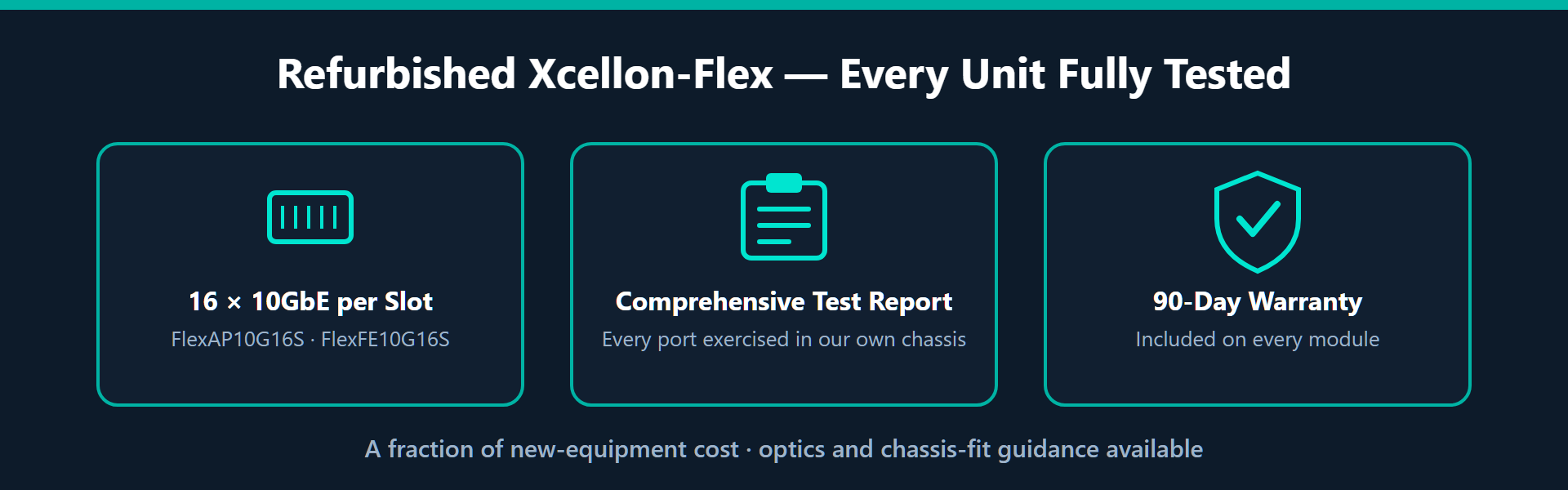
We carry refurbished Ixia Xcellon-Flex FlexAP10G16S (944-1060) and FlexFE10G16S (944-1061) load modules. Availability moves quickly — the product pages show live status, or contact us to confirm and reserve units.
Every refurbished unit we ship includes:
- A comprehensive test report — each module is fully tested in our own Optixia chassis before shipment, every port exercised, and the detailed report ships with the unit, so your lab has documented proof of functionality on day one.
- A 90-day warranty — included on every module.
- Significant savings versus new list price — 16 ports of 10GbE with IxLoad-class session scale for a fraction of the new-equipment budget.
Transceivers (10GBASE-SR, 10GBASE-LR, or direct-attach copper) are available separately — ask us about bundling optics with your modules. If you are unsure whether your chassis is an XM12 or an XM12 High Performance, send us the part number and we will confirm fit before you order.
View the refurbished Ixia FlexAP10G16S product page and order now →
View the refurbished Ixia FlexFE10G16S product page →
Or contact us directly for volume pricing, a sample test report, or chassis-compatibility guidance: Contact Zombie Components
Zombie Components LLC · 13177 Foothill Blvd, Sylmar, CA 91342 · +1.909.747.9984 · ahall@zombiecomponents.com